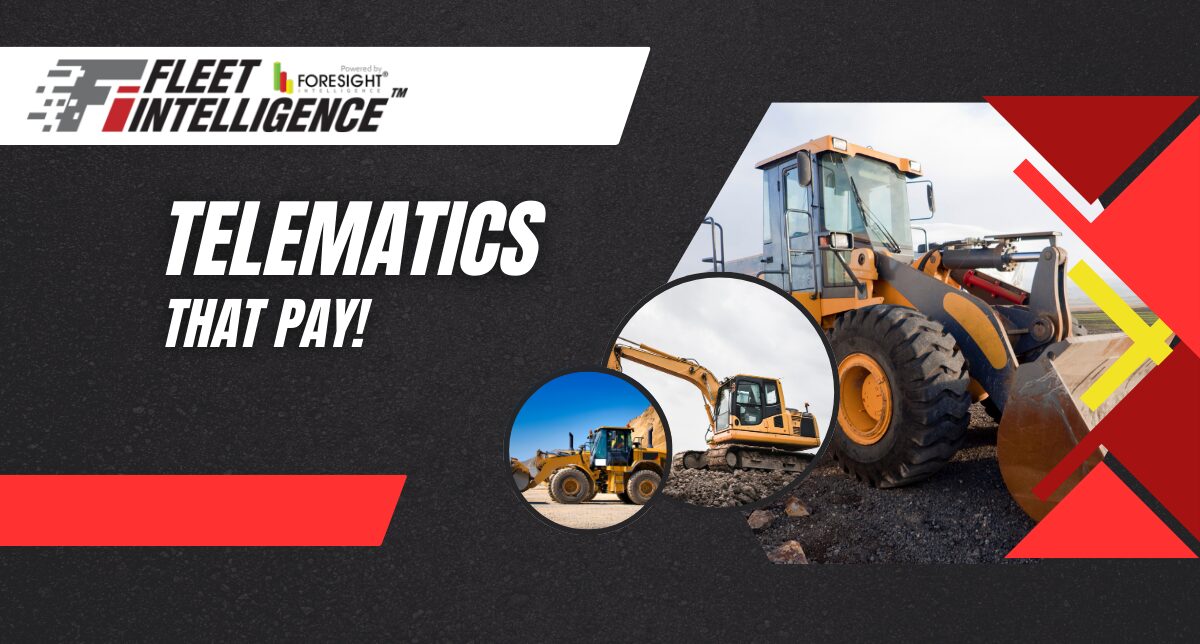
Let me be direct with you: most companies in fleet management and construction are leaving significant money on the table every single day. Not because they don’t work hard. Not because they lack talented people. But because they’re operating without the visibility that modern telematics can deliver.
I’ve spent decades in this industry, and I’ve watched the conversation around telematics evolve from a novelty to a necessity. What once felt like an expensive add-on has become the single most powerful lever companies can pull to tighten operations, cut costs, and protect assets. The numbers back this up, and I want to walk you through exactly where the return on investment comes from, because it’s more concrete and measurable than most people realize.
Knowing Where Everything Is — And What That’s Worth
Let’s start with the obvious: real-time GPS tracking. I know some of you have heard this pitch before, but the ROI story goes well beyond simply knowing “where your trucks are.”
The average construction company loses between 1% and 3% of its fleet value annually to theft, and that figure climbs sharply when you factor in untracked attachments, trailers, and equipment. This includes everything: excavator buckets, skid steer attachments, compaction equipment, and generators. The kind of assets that quietly disappear from job sites and cost tens of thousands of dollars to replace.
Here’s what the data tells us: companies that deploy active GPS tracking with geofencing and tamper alerts recover stolen assets at a rate over four times higher than those without. And more importantly, many of those theft events are prevented entirely. When bad actors know a fleet is monitored, job sites become less attractive targets.
Translation: a $20/month telematics subscription protecting a $120,000 piece of equipment doesn’t need sophisticated math to justify itself.
The Hidden Cost Center You’re Probably Ignoring
Fuel. It’s the budget line that everyone watches, but few truly optimize. Fleet fuel costs account for 25% to 40% of total operating expenses in construction and logistics operations. Even a conservative 10% reduction in fuel spend translates to hundreds of thousands of dollars annually for a mid-sized fleet.
Modern telematics platforms don’t just track location; they monitor driver behavior in real time. Excessive idling, aggressive acceleration, speeding, and inefficient routing are all measurable, all correctable, and all expensive when left unchecked.
Industry benchmarks are clear on this: companies that actively use telematics-driven driver coaching programs see fuel-efficiency improvements averaging 10% to 15% within the first six months of deployment. For a fleet running 50 vehicles at an average of $800/month per vehicle in fuel, that’s $48,000 to $72,000 back in your pocket annually, recurring, year after year.
Add route optimization to that equation, and the savings compound further. Fewer miles driven means less fuel burned, less wear on tires and drivetrain components, and fewer hours of labor time wasted in transit. These aren’t theoretical gains — they’re what our customers consistently report back to us.
Insurance Premiums: The ROI Most People Don’t Think to Calculate
Here’s one that surprises a lot of fleet managers when they first hear it… your insurance carrier may reduce your commercial fleet premiums simply because you have telematics installed.
This isn’t a marketing gimmick. Insurance underwriters assess risk based on data, and a fleet with real-time tracking, driver behavior monitoring, and documented safety compliance is measurably lower risk than one operating blind. Many carriers now offer formal telematics discount programs, with premium reductions ranging from 5% to 15% for qualifying fleets.
For a construction company paying $500,000 in annual commercial fleet insurance premiums, a 10% discount is $50,000 per year. That number alone can fund an entire telematics program, and everything else becomes pure ROI on top of it.
Beyond premium discounts, there’s the matter of accident liability. When a vehicle incident occurs, the question of what happened matters enormously. Telematics systems provide timestamped, GPS-verified, video-captured event data, speed at impact, braking patterns, location, driver identification. That data has protected our clients from fraudulent claims and has clarified fault in disputes that would otherwise have taken months to resolve and cost far more in legal fees than the incidents themselves.
Equipment Utilization: Are Your Assets Working — Or Just Sitting?
Here’s a question I ask every fleet and operations manager I meet: what percentage of your heavy equipment is actively working on any given day?
The industry average, according to data from construction equipment analysts, hovers around 55% to 65%. That means more than a third of the iron sitting on job sites or in yards is idle, depreciating, incurring insurance costs, and generating zero revenue.
Telematics changes this by giving you precise utilization data. You can see exactly how many hours each piece of equipment ran last week, last month, or last quarter. You can identify underutilized assets and redeploy them before you rent or purchase additional equipment. You can validate billing to clients on time-and-materials jobs. You can schedule preventive maintenance based on actual engine hours rather than calendar dates, which reduces unexpected breakdowns and extends equipment lifespan.
The financial impact here is significant. If a $250,000 excavator runs an additional 15% more efficiently due to smarter deployment and scheduling, the revenue and utilization benefit over a five-year ownership period is substantial, exceeding the total cost of a telematics program many times over.
Security Tracking for Attachments and Machinery: Closing the Blind Spots
This is a topic I feel especially strongly about, because it represents one of the most underserved areas in fleet intelligence today.
Most companies track their trucks and equipment. Far fewer track the ancillary equipment and machinery that lives on job sites. Attachments, trailers, compressors, light towers, fuel tanks… these assets collectively represent enormous capital investment, and they’re often completely unmonitored.
At Foresight Intelligence®, we’ve worked with clients who didn’t know they had missing attachments until they went to look for them weeks later. By that point, recovery is nearly impossible. The solution is purpose-built asset trackers: compact, battery-powered devices that can be covertly mounted on virtually any piece of equipment and report location, movement events, and tamper alerts in real time.
The ROI case for this is simple: a single $10 monthly tracking subscription preventing the theft of a $30,000 hydraulic breaker attachment pays for itself 25 to 30 times over in the first incident alone. And when you spread that protection across a full inventory of attachments and ancillary equipment, you’re not just reducing theft risk, you’re building an auditable asset register that supports insurance claims, equipment scheduling, and capital planning.
What a Real ROI Looks Like
Let me put concrete numbers to a scenario that reflects what many of our clients look like: a mid-sized construction company with 80 pieces of powered assets, and a significant inventory of tracked attachments and ancillary assets.
Annual ROI Snapshot: 80 Pieces of Powered Assets and Attachments
| Category | Annual Benefit |
|---|---|
| Fuel savings (12% efficiency improvement) | $72,000 |
| Insurance premium reduction (10%) | $25,000 |
| Asset theft prevention and recovery (1 major incident avoided) | $45,000 |
| Improved equipment utilization (15% increase in productive hours) | $38,000 |
| Maintenance cost reduction through proactive scheduling | $22,000 |
| Fraudulent claim defense and liability management | $18,000 |
| Estimated Total Annual Benefit | $220,000 |
| Typical Annual Telematics Program Cost | $25,000 – $35,000 |
That’s a return ratio exceeding 5:1, and it doesn’t yet account for the harder-to-quantify benefits: better driver accountability, improved client billing accuracy, reduced administrative overhead, and the operational confidence that comes from knowing exactly where your assets are at all times.
The Bottom Line
I’ve been doing this long enough to know that technology adoption in the construction and fleet world moves at its own pace. People want proof before they commit and that’s fair. The data in this article reflects what we’ve measured and what our clients report back to us, but every operation is different and every ROI story has its own specifics.
What I can tell you with confidence is this: the companies in this industry that are winning right now are the ones that have made telematics a core part of how they operate — not an optional feature, not a pilot program that never scales, but a fundamental operational tool that informs decisions every single day.
If you’re still running a fleet or managing job site equipment without comprehensive vehicle and asset tracking, you’re not just missing a technology upgrade. You’re leaving real, measurable money on the table, and your competitors are picking it up.
The question isn’t whether telematics pays. The data is clear that it does. The question is how much longer you can afford to operate without it.
— Foresight Intelligence® | Fleet Intelligence